From Mendoza, rode a Cata Internacional bus over the Andes and down to Vina del Mar, Chile ($25 USD per person) which is on the coast. Cata is to Chile as Andesmar is to Argentina in terms of quality, so if you’re going to do this ride (which we highly recommend), they’re a safe bet.
The 8-hour bus ride (including border crossing) showcases gorgeous valleys that cut through the beautiful Andes mountain range. On the Argentine side, you start off passing by one of the reservoirs that supply water to Mendoza (pictured above) and wind your way along a river where there’s whitewater rafting. Notice the change in landscape and vegetation as you go higher and higher in altitude:
Here’s the scene just before reaching Chilean customs. Mount Aconcagua and the national park is nearby as is a ski area on the Argentine side named Portillo(?). The multicolored strip you see in the photo below is a line of trucks waiting to go down to Mendoza because they’re doing construction on the highway, allowing only one-way passage at the moment.
And, on the Chilean side, after customs, you see the road snake down the mountain. We’re extremely impressed with the truck drivers that have to navigate this in 18-wheelers – and in this photo it’s starting to snow!
As a logistical note on the border crossing, Chileans take their customs control very seriously. No fresh animal/vegetable products or souvenirs made from animals/vegetables are allowed or they must be declared (in which case they are probably confiscated). There is a random baggage check/search before the bus is cleared for entry in to Chile.
Next up, we visit Vina del Mar and Valparaiso, cities on the coast of Chile northwest of Santiago. They’re supposed to be like Santa Monica and San Francisco respectively, so we’re excited!
“Wine Camp” at the Vines of Mendoza Estates was a special experience courtesy of the founders and executives of Vines of Mendoza, a startup wine development company. We believe this company is going to dominate the Mendoza wine scene. It has the premier tasting room in Mendoza proper, a wine bar at the best hotel in Mendoza (the Park Hyatt) and a huge wine estate in Uco Valley, where people can buy up parcels of 3 acres or more and make their own wine. Vines of Mendoza is full-service – they plant your vines, care for them until they’re ready to harvest, harvest them, then make and bottle your wine with a wine consultant (and your consultation of course). So, if you have some dough and love wine, we think this is a way to own your own little vineyard without any of the hard work.
So, as part of the wine camp, we got to harvest grapes by hand with clippers. Trust us, it really makes you appreciate the wine you drink and the price you pay for it because you have to squat down and clip grape bunches from rows and rows of grape vines. Not 5 minutes after we started, we felt the soreness in our backs and the amount of grapes we harvested was probably enough only for a bottle of wine.
(Note: This is one of Lisa’s first attempts at the Bokeh effect)
After harvesting grapes, we rode some horses to the winery facility. Despite Lisa’s smile here, she was deathly afraid of riding after falling off of a horse years ago in South Africa.
Here’s a view of a new vineyard (“Los Guapos”) at the Vines of Mendoza Estate – the owner of the parcel was visiting it for the first time.
Here’s Lisa sorting grapes and removing excess stems. The irony of the experience was that we paid to have this experience … while the workers were getting paid to do it.
Here’s Tony after squishing some of the must (grape mixture). The juice really soaks and stains your skin.
After sampling some juice before and during fermentation, we rode horses over to a traditional asado. Yes, I look quite manly on this horse 😉 but I’ll admit that it was more punishment than enjoyment – basically it was like getting kicked in the balls repeatedly for 2 minutes while holding on for dear life while the horse galloped seemingly out of control. Obviously, I didn’t know how to ride, so I ended up with some nasty blisters from hanging on to the reins and saddle. Nevertheless, it was still fun!
Here’s the asado – some of the best meat we’ve had during our entire time in Argentina to date. We had beef, chicken, the juiciest pork tenderloin, blood sausage, regular sausage, among other meats!
Here’s Uco, the Vines of Mendoza mascot, begging for food from the asado – she’s a pro.
See more photos from the wine camp on the slideshow
Mendoza (and Argentina in general) is well known for its Malbec wines because the grapes do well in the terroir, the ideal, predictable climate, and lack of bugs and disease in the region. It was originally planted in the Bordeaux region, used as a blending grape. The grape wasn´t know for it´s taste – “malbec” literaly means “bad mouth” in French. But it was wiped out in 1956 by frost, at which point it lost its popularity. It has found a home in Argentina and only in the past 10-15 years have Malbecs really taken off in the world market. More info on Malbec at Wikipedia.
We spent a week in Mendoza going from bodega to bodega (winery), tasting their wines and learning about the winemaking process. At each place, they give you a presumably required tour of the facilities and how they make their wine. Well, after visiting 12 bodegas and having 12 tours in both Spanish and English over the course of 12 hours, we felt like we could give the tour ourselves. So, here you’ll get the benefit of all of that in less than 10 minutes.
How Wine is Made (in Mendoza)
Grapes are usually harvested in the Fall, albeit some are harvested earlier and some later – it depends on the varietal and how ripe the fruit is. First, the grapes are dumped in to the first vibrating belt above that filters out small grapes automatically, and the workers manually remove the bigger stuff, like leaves and green, undeveloped grapes which give wine a very green, bitter and unpleasant flavor. You’ll taste this in cheaper wines because they don’t have this manual quality control process. The workers are also removing overly dried grape bunches, also known as raisins, which contain too much sugar. The excess sugar would make the wine overly alcoholic and thereby affect its taste, and since Mendoza produces grapes with high sugar content, they opt to remove those drier grapes here. In other appellations, like in France for example, they may keep those drier grapes because they need the sugar to bring up the alcohol level and fruit flavor of the wine.
The grapes then go through a destemmer:
Then, on the second vibrating belt, workers are looking for remnant leaves and stems. It’s a tedious job – cool for the first minute or two, like a new video game, but then becomes quite monotonous. This woman looks concerned not because of her job, but because I started to take a lot of photos:
The grapes, sans leaves and stems, are dumped in to these small vats which are then easily transported to the appropriate tank, which are the round caps in the ground.
Here you see the grapes being dumped in to a fermentation tank:
Again, this winery, O. Fournier, touts using gravity as an advantage in its wine making process. They don’t need to pump their grapes in to the tanks, they just dump it in. And that’s supposed to reduce the amount of processing done on the grapes and reduce energy consumption. I think it’s more of the latter. Fermentation To convert grape juice to wine, you have to let it ferment – yeast is added to the tanks which convert the sugar in the juice to alcohol. But before that even happens, some wineries actually chill the juice to a couple of degrees above 32 F, right after it gets in the tanks to delay fermentation and to allow the juice to absorb more flavor from the grape skins. The whole fermentation process takes about 20-30 days in total during which the winemaker is constantly monitoring the temperature and sugar levels (“brix”) to see when fermentation has reached a desired level. Here’s a view of the fermentation tanks at O. Fournier. These are made of French oak, only used for the top label wines because they are $36,000 each and imported from France. The idea is the wine will begin to absorb some of the wood notes from the beginning of the fermentation process as opposed to just barrel aging.
Most wineries, though, will ferment their mass-produced wine in stainless steel tanks because they’re a helluva lot cheaper:
Some wineries in Mendoza use cement fermentation vats coated with epoxy paint. I don’t think they do this in the U.S., so it was interesting to hear about it. The idea, so they say, is that the shape of the vats provide natural circulation properties during fermentation and that the cement provides good temperature insulation. The epoxy paint is used to prevent the wine from absorbing flavors from the cement which is quite porous. Inside the vat here you see a metal radiator, used to help control the temperature before and during the fermentation process.
Here they are at O. Fournier, recycling the grape mixture from bottom to top during fermentation. Again, they tout the idea that gravity is helping in the mixing process.
In some wineries, they have workers manually stir and mash up the “must” (grape mixture) using these long pole stirrers. Think of the little plastic coffee stirrers/paddles you get at Dunkin Donuts, but instead, imagine that it’s made of steel, 10 feet long, with a 1″ x1″ grate at the bottom of it. This is to ensure more uniform fermentation as well as continuing to mash up some of the grapes.
During the whole fermentation and aging process, the winemaker and his/her assistants are constantly monitoring the progress of wines, from checking temperatures and brix (sugar) levels during fermentation to continually sampling what’s in the barrels over the course of the wine’s life (“crianza”) in barrels. It’s quality control, folks. Here’s O. Fournier’s laboratory. In almost all of the wineries, they’ll have a room dedicated to this:
After fermentation, a hydraulic press is used to separate seeds and skins from juice:
Aging the wine in barrels After the fermentation process, the wine is stored in French or American oak barrels for anywhere from 6 to 24 months, depending on the winemaker’s preferences. The general idea is you want the wine to absorb tannins from the barrel wood, giving it different flavors in addition to the woody/oaky notes you can sometimes smell on the nose of a glass of wine. Tannins also give wine that astringent/dry taste that makes you want to smack your lips – think Cabernet Sauvignon or Syrah. From a chemical perspective, tannins can be thought of as a preservative that allows you to age wine longer, where aging causes the wine to develop different (and better, depending on your tastes) flavor. In general, the more you age wine, the smoother, less dry, it will taste, and the color of the wine will be duller. The barrels are stored in a cool, climate controlled room – a wine “cave”. Some wineries have added form to function, like O. Fournier. Here, they consider it to be a work of art, literally. The cathedral-like space is set up to let light in from the ceiling in the form of a cross and doubles as an art exhibit with pieces hung on all of the walls in the complex.
Here’s another dramatic wine storage room at Bodega Salentein, also in Uco Valley. You can see in this photo that it’s an amphitheater where they’ve had piano concerts. The balcony above is the room where they have all of their fermentation tanks.
Your basic, non-touristy winery most likely has a more functional take to wine storage: it’s usually a large room/warehouse with cool temperature and stacks of barrels. Here’s the winemaking/storage facility in a tiny winery called La Azul (<40,000 bottles/year). The stainless steel tanks are right next to the barrels where they age their small production reserve wines. Nothing dramatic here – this is how wine is made:
Bottling and Labeling Finally, after the wine is done aging in barrels, it gets bottled, labeled, and packaged up for shipment. Interestingly, in Mendoza, the overwhelming majority (> 80%) of wine is made for export. Word has it that Argentinian tastes are changing to favor beer and soft drinks over wine. At some wineries like Achaval Ferrer in the Lujan de Cuyo appellation, they still bottle and label everything by hand. They can do this because they don’t produce that many bottles a year (< 500,000 a year). These guys consistently get 90+ points in Wine Spectator… and their wine is also > $70 per bottle, presumably due to the artistry, care, and manual labor that goes in to making the wine.
Many of the larger wineries either own or rent (mobile) machines that do the bottling and labeling process. Here’s a labeler machine doing a test run at Finca Decero winery:
And that, my friends, is how wine is made in Mendoza. Now here are more photos from our time there:
Mendoza is a city of about 1 million people nestled along the Andes mountain range on the central-western edge of Argentina. As you may know, it’s place well known for producing world class Malbec wines. What you may not know is the popularity of the Argentine Malbec is a fairly recent phenomenon, rising to fame only in the past 10-15 years. In fact, when the Argentine peso was devalued in 1999-2002 during Argentina’s economic crisis, a lot of foreign investors came in and helped develop the region. So many of the wineries (and therefore many of the wines) in the area are very new. (As a side note, that’s why it’s rare to see a wine from Mendoza that’s older than 2004/5. Prior to the 2001,, most wineries sold all of their wine each year and the idea of ‘laying down’ or building a wine library didn’t really exist, except at a few wineries).
There are now over 1000 wineries in the Mendoza region and wine tourism is fairly developed with several wine tour agencies started by ex-pats catering to foreigners. One company, called Vines of Mendoza, is importing a business model familiar to those in the U.S. – they’ve opened a tasting room and wine bar, allowing visitors to sample flights of wine from many different wineries. They are developing a massive vineyard estate in Uco Valley, south of Mendoza, where you can buy a full-service vineyard (3-acre minimum) and start producing your own wine. Full-service means they plant your vines, care for them until they produce fruit (2 years) and make the wine for you, with your consultation of course.
Through a friend, we were fortunate enough to meet Duffy, an executive of Vines of Mendoza. This connection led to our adventures at “wine camp” which we’ll write about in a future post. (Thanks Duffy!)
“Tourist Traps”
One of the first things you’ll see when you visit Mendoza are the irrigation ditches that line just about every street. One local ex-pat quipped that they are “tourist traps” – where if you’re a tourist, you’re too busy looking around (or drunk from wine) that you’ll inevitably fall into one of these ditches and injure yourself badly. Though we didn’t fall in to any traps during our stay in Mendoza, I am absolutely certain they’ve put a few tourists in the Emergency Room. Here I am, reenacting it on one of the smaller ditches – don’t try this at home, folks:
Seriously though, these irrigation ditches serve a very valuable purpose in Mendoza. All of the water comes from snow melt in the nearby Andes and so this is the way the municipality meters out and distributes the water. Basically, they’re water pipes above ground.
Life in Mendoza
On the weekdays, Mendoza buzzes about like a large city does, complete with cars honking, buses revving, and people walking briskly by, trying to get to where they’re going as soon as possible. Business starts up around 9am and then shuts down at 1pm for lunch and siesta, reopening around 4:30 or 5pm until 8 or 9pm. In the evening, restaurants typically open at 8pm at the earliest and stay open past midnight.
During siesta, things are very quiet – people actually do go take naps at home. One would think you double the commute time needed per day by having to go home twice, but since things are pretty close and the traffic isn’t terrible, people seem to go home, at least according to a driver we hired. That means FOUR rush hours per day!
As a visitor, there are a couple of other things you notice. Crossing a street on foot is like playing real-life Frogger (1UP only!), or if you’re in a car, it’s like playing chicken. There are many intersections without stoplights – call’em death streets – where the game goes like this: roll up to the intersection at near full speed to signal that you’re definitely going to cross and there isn’t the slightest chance you could stop in time so that the cross-traffic is forced to stop. Sometimes it works, sometimes it doesn’t; and when it doesn’t, you see one car slam on the brakes though without screeching. It’s just the way the game is played and the locals say they rarely see an accident. There were many occasions where we’ve been in the back seat of a cab, crossing the intersection, and seeing a car come a few inches away from t-boning us.
Such is city life in Argentina I suppose. By the way, this game is played in just about every Argentine city we’ve been to. Now, go back and imagine crossing the street on foot when this game is being played!
Sundays
In contrast to busy weekdays, Sundays in Mendoza are eerily quiet. It feels like one of two things: either you’re living a scene out of a horror movie, or there’s a party or soccer game somewhere that everyone knows about, and you’re just not in the know.
So, we asked a local where everyone goes. Sunday is a family day where people get together for asados (big backyard barbecues) or hang out in the park, like the one below. Here’s a water fountain/show in the Plaza de Indepedencia in the city center, reminiscent of the one at the Bellagio Hotel in Las Vegas (use your imagination!).
Aside from families lounging in parks, you’ll see a lot of young adults making out in public. This is presumably because most people still live with their parents, so privacy is found in public places. Sound familiar, or oxymoronic?
Great Food
Since Mendoza grows grapes for wine, it follows that it can also grow other crops well (olives, leafy vegetables, peaches and other fruits). So, gastronomic expertise is not far behind. In fact, we liked almost every restaurant we went to, whether they catered to tourists or locals. Here’s a look at some of the restaurants:
Azafran – one of the most oft mentioned restaurants to try in Mendoza. It boasts a wine room with sommelier where you can choose your wine for dinner. Azafran definitely caters to the foreign palate and the prices are as such. Unfortunately, we disagree with most people in that this restaurant was not worth the premium you pay to eat there. There are PLENTY of other restaurants within a few blocks that are much better – for half the price. We can say this because we went back to Azafran twice to give it another chance, but it was average at best.
La Flora – this restaurant is a block or two away from Azafran and is a much better option. It features good light fare, like a mixed green salads with strawberries, with richer options like osso bucco ravioli and your requisite bife de chorizo steak.
One other thing you see is lots of outdoor seating. The Argentines love to dine outside almost regardless of how cold it is outside.
And for course, it wouldn’t be dining in Mendoza if the restaurant didn’t have a kick-ass wine cellar. Here is one of our favorites at a restaurant called Francesco Barbera. The bottles we are holding are Double Magnums (each holds 4 bottles of wine).
And now, for some food pics that show off the culinary sophistication you can find in Mendoza – this is a mixed greens salad with blue cheese, honey glazed pecans, green apple slices and a light citrus vinaigrette at Salentein Winery’s cafe:
Here’s flank steak for lunch at the Decero winery:
And, beef wellington, medium rare, at Azafran. We’ll admit that this dish saved Azafran’s reputation for us.
And finally, on our last night in Mendoza, we went to Don Mario, a parilla where the “who’s who” power brokers of the wine industry go to do business. Here’s Brian on his first day as a legal intern with Vines of Mendoza, about to consume a bife de chorizo (rump steak) the size of his head. This dish arrived after we each had a provoleta (a slab of grilled provolone cheese marinated in olive oil and oregano) and chorizo sausage. He finished about half of the steak before Duffy stopped him for his own well-being. Duffy is Brian’s boss for the next few months. 🙂
Next up, how wine is made (in Mendoza) and our adventures at “Wine Camp” courtesy of Vines of Mendoza. But in the meantime, enjoy these photos from Mendoza:
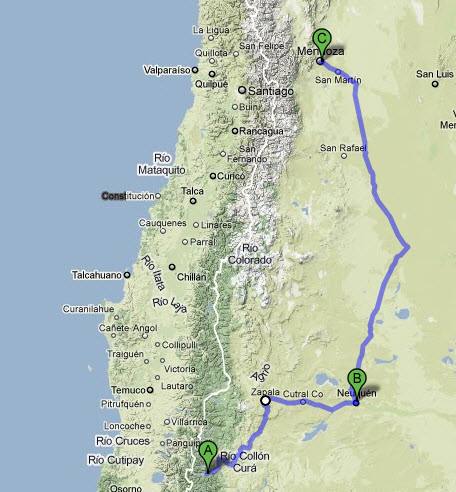
Call us weird, we were really looking forward to traveling via a long distance bus. We got our chance, going from San Martin de los Andes to Mendoza, via Neuqeun.
The terrain from San Martin to Neuquen is pretty much a high desert and according to our friend Joey, what the majority of Patagonia really looks like, not what you see in Torres del Paine in Chile or in El Chalten, which are super exotic.
Here we are an hour in to the trip to Neuquen:
And 2 hours later:
And 4 hours later:
Before reaching a small town called Cutral Co, which is known for its oil and dinosaur fossils as seen here in the structures you see as you enter the town:
After reaching Neuquen, we catch our connecting bus on Andesmar to Mendoza, a 10 hour bus ride, but we got the “First Class” seats which feature 180 degree reclining seats!
Well, in first class, you get to play Bingo – yes, bizarre, but if you win, you win a $10 bottle of Santa Julia Cabernet!
And though there’s a depressing dinner onboard, you finish it off with a glass of champagne… not bad!
Next up, 12 wineries in Mendoza, great food, and wine camp.
Lake Huechulafquen and the Volcano Lanin are two other attractions near San Martin de los Andes – they’re well worth the price of the tour if only for the views. But, be advised, the tours are only in Spanish.
First, we stopped of in Junin de los Andes, a town just north of San Martin de los Andes, known as a fly fishing mecca for trout. With pristine, clear rivers, we have no doubt that that’s true, and should have motivated ourselves to learn how to fly fish.
About 45 minutes north of Junin, we reached Lake Huechulafquen, the largest lake in the Lanin Park, which also has views to the Lanin Volcano, which you can climb to the top with some hiking and ice climbing.
Whilst we were enjoying a brief hike in the forest, we came across this sign which advises of fire danger:
But, then we also saw this gentleman hiking in front of us smoking and flicking ashes in to the forest. Didn’t quite catch him in the act, but WTF!?
Smokey the Bear, the park ranger, would not be happy at all. Unbelievable.
Here’s an interesting and colorful beetle we saw in the forest:
Finally, here’s a video of the waterfall we hiked to:
We’ve been in South America for about 3 weeks now and we’re starting to feel the bulge – put simply, we’re getting fat. Oh yes, long gone are the days of training for the Malibu triathlon. After weeks of great steaks, barbecue, heavenly raviolis, pizzas, chocolates, ice creams, artisanal beer and wine, the calories are starting to catch up with us despite all of the hiking and walking around town.
San Martin de los Andes is a smaller version of Bariloche, but we like it much, much better. It’s a town of about 30,000 people, which is super busy in the summer with its beautiful lakes and excellent hiking, and then skiing in the winter. In between seasons though, it’s a sleepy town where you can enjoy its fantastic restaurants without reservations.
For us, San Martin was about relaxing and staying in one place for more than 2 days, because we had been traveling constantly for the past few weeks. In fact, we stayed for a week and a half, with the highlights being a few tours to the national park which we’ll write about in subsequent posts, and more importantly, the great food that we ate. Here are a few choice photos of things we ate and the places we ate at.
Our favorite restaurant in San Martin was Cerveceria El Regional pictured below. As you can see, it’s quite cozy and it features local cuisine (lots of great trout dishes), amazing ravioli dishes (we went back twice), and a great selection of local beers… mmm beer.
Deer (ciervo) and wild boar (jabali) skewers:
Lamb raviolis… mmm…
Enjoying an “El Bolson” beer, made in El Bolson, Argentina, which makes 2/3 of the country’s hops.
And here’s a view from the “Wine Bar” in the Paihuen Mountain Lodge, overlooking Lago Lacar:
San Martin isn’t just about great food – it, too, has excellent chocolates. Here, at Mamusia (maybe a Mamuschka knockoff?), they make stacks and stacks of chocolates. Mmmm… chocolate.
This chocolate store was just across the street from our favorite cafe/pub — Dublin. Dublin offered great sandwiches, coffees and cervezas and had reliable, fast, free Wi-fi. As a result, we ate (or drank) here nearly everyday we were in San Martin.
Well, after all the chocolates and food, we felt like we needed to eat healthy (e.g. try to cook in our apartment “kitchen.”) I put the word kitchen in quotes because after starting to heat the pan and coating it with oil, the spatula I was using melted upon contact. Now, mind you, the gas was only on for only 15 seconds…
So, we ended up sauteeing the chicken in a pot. While we were going to make a salad, the lettuce we bought looked awful and very sad, so we skipped and made what you see here… disappointing. It should make you feel grateful you have the cookware you own and the produce you have in the States:
Yes, that bag in the tin can was basically rock salt we used to season the chicken. Note to everyone, don’t use rock salt as liberally as you would table salt. 😉
On another night, we decided that a chicken stew would be easier given the basic supplies we had (salt, merquen (a spicy pepper), chicken, and veggies), but there were no adequate bowls to eat it in. So we had soup out of the pot, like we did with ramen in college. It was quite good though!
San Martin de los Andes borders Lago Lacar in el Parque Nacional Lanin, an enormous national park stretching from Bariloche in the south to a town called Alumine in the north and covering over 1 million acres. Since the locals say take the boat tour, that’s just what we did. It cost about 160 pesos per person ($40USD) and took most of the day – we thought it was well worth our time. Note that the tour guides don’t translate to English, but we understood bits and pieces with our basic Spanish skills.
Lago Lacar is a remarkably calm lake – so calm and clear that the water looks like jello; so zen, that you could stare at it for hours, medidate, and then get a speedboat to wakeboard through it… though, that hasn’t quite caught on here yet. Maybe it’s because the water is super cold (the lake was formed by a glacier after all). And yet, there was a tour agency promoting scuba dives off a small platform at the edge of the lake. Anyway, check out the reflections off the water:
The boat stopped at several destinations, including a 30 minute uphill hike to the Cascadas Chachin. They rated the hike as medium skill – it definitely gets your heart pumping:
And a stop at Hua Hum, near the Chilean border where we met a couple of territorial geese with insatiable appetites that we named “Homer” and “Marge”. These guys “honked” as we stepped off the boat (translated “feed me, moneybags”), would hiss like a snake if the dogs on the beach got near them (translated “get the f*ck away from me”), and then honk again if a human or dog got near the water which was their home (translated “oh hell no”).
And then again, you could get hypnotized by the water:
Just about everyone we talked to told us to spend less time in Bariloche and to move on to Villa La Angostura and San Martin de los Andes via the “Camino de Siete Lagos”.
Villa La Angostura is only an hour away from Bariloche and is an upscale, quieter alternative to Bariloche. It reminds us of Malibu the way it’s set up, with a few commercial and residential strips strung out along a highway. We stopped there for a few hours and were able to explore some of the area (La Cruce and Puerto Villa). Here are the couple of restaurants at Puerto Villa:
And a view of the dock at Bahia Brava in Puerto Villa:
And some stores at La Cruce – look! Lisa has a new amiga!
A Digression About Dogs
Despite being a quiet, picturesque town (which it truly was), we had a scary moment. As we were trying to hike down to Puerto Villa, we came across a pair of dogs that were running up to and barking (read: attacking) cars as they drove by. As we got closer, we saw one of them appeared to be foaming at the mouth and so the first thing we thought was rabies – strange, aggressive dog behavior and foaming mouth = probably a bad situation.
So we decided to walk back to town, but as we did, the two dogs started to herd us and follow us around, though not attacking or barking at us. A bit disconcerting, so we finally lost them (read: we high tailed it for a taxi). Later, on our bus ride back from Puerto Villa, we saw they were following another couple down the road.
So, crisis averted in the end. Out of curiosity, I wonder at what point municipalities around the world develop the notion of animal control, as in, after all the basic stuff like water, roads, education, etc., does it come after parks and traffic signals? Low priority? In general, probably. Thus far in our travels – from large cities to small – there have been strays wandering around. Some towns, like El Calafate, have many dogs on the streets. We were told that many, in fact, do have owners, but that they are not socialized and are allowed to wonder — and can be aggressive. A British citizen was bitten after trying to pet one and ended up in the hospital!
For the most part, dogs seem to do their own thing e.g. sleeping and peeing on a signpost, unless they’re begging for for food, in which they become very friendly and submissive. In Bariloche, at El Boliche de Alberto, a German Shepherd came to the door of the restaurant and started barking every 30 seconds or so. We then saw the hostess at El Boliche feed it a 1 pound hunk of raw beef! Man, that was a tenderloin or something! Maybe the dog belonged to the owner? Wow. Sure beats the kibble we feed our dogs in the States! Do they get a premium Malbec with that? 😉 More recently, in San Martin de los Andes, we had a dog follow us home to our hotel. She was actually sweet – she would only follow behind us (we could hear the little click clack of her nails on the side walk) and she copied our pace, so when we stopped, so did she. Then, when we got back to our hotel, she sat at the door wagging her tail with ears flapped back, hoping for food. We named her Sally.
El Camino de los Siete Lagos
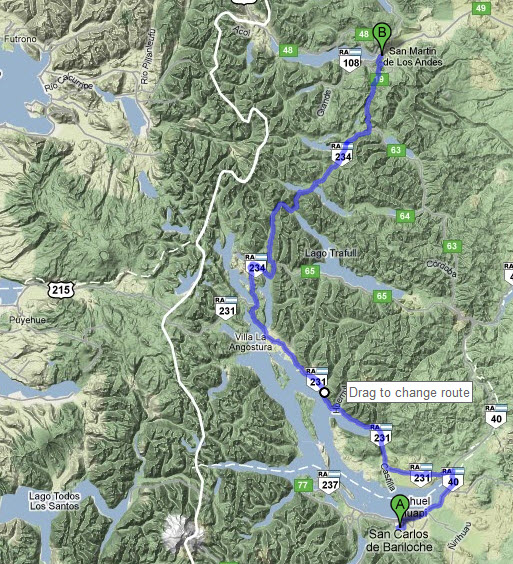
From Villa La Angostura, we took a bus along a mostly gravel road called the Camino (or Ruta) de los Siete Lagos (or Seven Lakes road) to get to San Martin de los Andes. Here’s the route – you can see it passes through the mountains and along several lakes, hence its name:
It reminded us of driving down the California coast, albeit with lakes instead of the ocean. Unfortunately it was a bit cloudy, but here are some pics:
A Dirt Road and Argentine Federalis
We were surprised at how poor the road was given the popularity of this route and the towns located on the route. For much of the ride from Villa La Angostura to San Martin de los Andes, the road was not paved, it wasn’t even a gravel road. We saw that they had started major road and bridge work – presumably to pave it – but they have a lot of work ahead of them. It made for a very bumpy, swaying ride.
At one point, we were stopped (along with all other cars and trucks) at a road block. The Argentine federali (federal police) boarded our bus. They seemed to target young, seemingly single males and asked to see their ID. They actually asked one young man to get off the bus while they searched his bag and questioned him. They saw Tony – sitting next to me, wearing a hat and sleeping – and asked for his “documentos”. Since I had our passports, I quickly reached into my purse to produce Tony’s passport. The look on the face of the young federali was priceless! You could see the thoughts cross his mind – “Hmm, single man. Oh wait, he’s Asian…. Oh wait, he’s not alone…oh wait he’s American.” Luckily the process lasted a few minutes and we were quickly on our way. We later learned that this road block was probably the result of a child kidnapping in Chile. Apparently such roadblocks are part of the two countries’ collective efforts to stop human trafficking (which we understand is rare) – similar to our Amber alert.
After an eventful day of scary dogs, bumpy buses and federali, we were very happy to relax in San Martin de los Andes!
Bariloche is known for its sweeping lake views, winter sports, Swiss/German-inspired architecture, chocolates, and excellent food. Word has it that it has become much more touristy in the past couple of decades, being overrun with high school kids at the end of the school year (think Cancun) and overdevelopment. That said, it was still a beautiful place and fun to try the chocolates and ice cream, said to be the best in Argentina.
“Oh, look at all the options!” thought Lisa. A bit overwhelming, if you ask me!
We also had a couple great dinners at El Boliche de Alberto, which apparently has over 3 locations in Bariloche itself… Alberto must be doing alright for himself, and he should. Even though it’s cheaper than other parillas and more about turnover than being pampered with service, the food was excellent. Beef tenderloin was like butter and we ordered a mountain of fries, literally.
The raviolis we had the next night were made fresh, as can be seen here.
And finally, we had an unexpectedly good lunch at Kostelo overlooking the lake. It isn’t listed on Lonely Planet or Tripadvisor and looks like it should be pricey because of its swank atmosphere, but it’s fairly-priced and worth a try. Here’s my smoked trout sandwich with avocado, cream cheese, and an herb aioli with roasted potatoes wedges. Yum.