Categories
Chile

Santiago, Chile – Seafood, Friends, and More Seafood

Dinner with Sergio and Marina at Casa Vieja, in Nunoa barrio of Santiago

Total Miles Traveled: 12,096

After a couple of days of wine tasting in Colchagua Valley, we headed back to Santiago in Chile.  For us, Santiago represented two things – friends and seafood, as you’ll see in the photos featured here.

Pictured above, we’re at dinner with Sergio and his wife Marina.  Sergio is a former criminal attorney who, after going to Florida (Hallandale) for a year sabbatical, ended up staying there for several more years.  It was there he met his neighbor, George, whose son Eddie, is a good friend of mine (Tony) from my days at NetworkOil in Houston.  I had met Sergio at Eddie’s wedding a few years ago, and looked him up before we headed down to South America.

Sergio took us to George’s favorite place, Casa Vieja, in the Nunoa neighborhood.  And the way they treated Sergio, it seemed like he was the Godfather – he knew all the waiters, had his favorite waiter, and his favorite table.   Here’s a mixed seafood dish with calamari, shrimp, razor clams, and clams:

We also got the opportunity to meet up with Nico B. and his wife, and Meto. Z, classmates from MIT Sloan and native Chileans.  We caught up over, you guessed it, another seafood dinner. 🙂  Nico had “congrio a lo pobre” which was an impressive, heart-unhealthy dish – but looked oh so tasty.  Unfortunately, I must have been in so much awe that I forgot to take a picture!  Anyway, congrio is a cod-like fish (called “kingclip” in South Africa – Lisa’s favorite fish of all time) and very popular in Chile.  “a lo pobre” means literally “of the poor”, but the preparation is fried, with onions, and fried egg.  Yum.

Getting our priorities straight – eating seafood

Since we had been eating beef for 6 weeks while we were in Argentina, our highest priority in Santiago was to eat seafood.  And so, one of the first things we did was visit the seafood market in Santiago!

Donde Agosto, in Mercado Central, Santiago

The seafood market is an experience in itself – part of the building is dedicated to actually selling seafood with fishmongers hawking passersby, whether they were tourists or potential customers.  We were warned about carrying flashy cameras around for fear of them being stolen, but having been there now, I’d say it’s OK , especially when it’s not busy.   Definitely potential for lots of great photos, but alas, this is the best I could manage between my anxiety and all the hawkers constantly talking to us:

Mercado Central, Santiago

The other side of the building is full of restaurants and as soon as you cross from the market in to the “food court” area, you’re accosted by waiters/promoters who ask if you’re hungry or how they’ve got the best seafood.  You can’t take a few steps without a new waiter coming up to hawk you and you saying “No gracias”.  Think it’s competitive in there?

In any case, we didn’t feel like getting roped in to any hole in the wall, so we opted for where we saw the most people eating, which was out in the open.  We ordered “curanto” (pictured below), which is a famous seafood stew from the island of Chiloe in south-central Chile near the Lakes District.  We didn’t visit Chiloe because it was raining the whole time we were near by, and the only thing we really wanted to try had been the curanto.  Looking back, we probably should have gone just to have a look around because the Chileans say it has a totally different culture due to the Indian tribes that live there.

Curanto is like the trash can soup.  It includes all kinds of shellfish (clams, razor clams, oysters, abalone, mussels), fish, big slabs of ham, a quarter chicken, and sausage, all thrown in to a pot and stewed for hours.   The result is a really REALLY flavorful broth as you imagine.  The seafood itself might have been better prepared some other way so it would be less tough from overcooking/boiling, but nevertheless, it was fresh and still very good.   The picture below is “before” we dug in, but the “after” photo wouldn’t look much different – and we left feeling VERY full.

Curanto Stew at Mercado Central, Santiago

On another afternoon, we went to Bar Liguria which is a well-known chain here in Santiago.  It features rich, comfort food and a wide selection of tragos (mixed drinks).

Here’s a cazuela de loco – or abalone casserole.  Our guidebook said that loco was a delicacy here, and although I had tried it in a salad in Vina del Mar (which I couldn’t finish by the way because I really didn’t like the texture of cold, boiled loco), I decided to  give it another shot.   I though it was going to be a hearty stew, but didn’t expect to see this below.  Well, between all the cheese and cream and other rich stuff inside (I think there was sausage), I was bound to like it.   Do you think I did?

Well, it was good, but wayyy too rich.  I couldn’t even finish it.  And I’m convinced now that I still don’t like abalone.  Just too chewy and I don’t like the flavor.   I guess I do have dietary restrictions after all.

Lisa got a braised cordero (goat) served in ragout, to take a break from all the seafood we had been eating.  It was good, but we’ve had better in Argentina.

Another dish we ordered a lot of was Peruvian-style ceviche, where the lime-marinated fish is served in chunks with thinly sliced red onion, avocado, cilantro, and sometimes spicy peppers.   We prefer it spicy because it has a lot more kick to it and it was soooooo good to have spicy again (while the Argentines love salt, they don’t like hot spice)


Santiago is more than just food

So we did do more than just eat in Santiago…  We managed to get out of our small hotel room at Hotel Orly in the Providencia neighborhood and explore the city.  Here’s a photo from inside the hotel – pick a room, any room.  Reminds us of buildings in New York.

Hotel Orly

Here’s one of the pedestrian malls/promenades in the central business area/centro of Santiago.  Packed with people and good for people watching.

Pedestrian Mall in Santiago centro

And finally, we took an afternoon walk up to the Parque Metropolitano, up Cerro San Cristobal (hill) to get a few of Santiago above.  Unfortunately, the gondolas were out of operation (maybe from the earthquake?) and it was a bit hazy/smoggy that day.

At this point, we had to make a decision of where to go next.  Mostly for budget reasons, we ended up deciding to go back to Argentina.  We would spend time in Mendoza for a few days before heading to Salta in northwest Argentina.

Here’s the complete set of photos from our time in Santiago (but FYI you’ve seen most of them already): http://www.flickr.com/photos/tony-chen/sets/72157623960164372/show/

Categories
Chile

Clos Apalta Winery – Makers of the Best Wine in the World in 2008

Clos Apalta Winery is probably considered the top winery in Chile because its Clos Apalta 2005 vintage won the Wine Spectator’s Best Wine in the World designation in 2008 with a 96 rating (if that means anything to you).  As such, they charge a hefty – OK, I’ll say it – offensive, $40 USD per person for a tour/tasting.  We didn’t know how expensive it was beforehand since most other wineries charge far less, but since we had come all that way, we just plowed ahead.  So, we’re writing it up separately to amortize the cost, by sharing it with everyone we know.  🙂

This winery, owned by the wealthy Lapostolle family from France, knows how to spend money and make money.  In fact, money is no object at this winery – spare no expense!   You’ll see why in the rest of the photos below.

Upon entering the estate, you drive about 1 km alongside beautiful vineyards of Carmenere, whose leaves turn in to a stunning red color in the Fall, before reaching a junction leading to the winery or the Lapostolle Residence.

The Lapostolle Residence is a set of high luxury villas, costing over $1,000/night.  The story goes that these villas were originally built for the Lapostolle family to vacation in when they were visiting the winery.  But, guests began to call about them, asking if they could stay there and how much it would cost.  The owner threw out a number that she thought would be obscene – so obscene that people wouldn’t pay for it.   Well, they did pay, and so the villas became a business.  Now, knowing this, think back to the tasting fee we paid… hmm…

The Winery

Here’s the winery building again.  It’s built to resemble a bird’s nest, with each wooden “rib” representing a month that the wine stays in French oak barrels.   Pretty cool… but it gets better.

When you pay $40 for a tasting, you have to think there’s a reason for that other than the fact they won an award.  Well, it’s because the overhead cost of producing this wine is exorbitantly high.  Take a look at the grape sorting scene here – they employ over 50 women to HAND PICK the grapes off the stems, after which the grapes are put on to a conveyor belt for final filtering and chilling.  Every other winery we had been to used machines to de-stem the grapes and only 6 people maximum to do the sorting, etc.

Here’s the fermentation room where they ONLY use vats made of French oak.  Remember, these things cost over $30,000 each and are shipped in from France.  Many other wineries will only have 3 or 4 of these (if at all) with the rest being stainless steel tanks.

Here’s the wine cave/tasting room where wines are stored for their first 12 months.  The ceiling is structured to resemble the inside of a barrel and has tiny lights embedded in it to provide ambient lighting.  This picture doesn’t really do it justice – it really is a beautiful space and experience.

The Clos Apalta Wine

Now, let’s talk about the wine.  We tried 3 wines, 2 of which were a “lower tier” label (not called Clos Apalta) produced at another facility.  Don’t get me wrong, they were still very good and if I remember correctly the price per bottle was less than $30.

There was one little mishap though (apologies for the ranting), our tour guide – a young woman probably a year out of college – served us corked wine, wine that had already gone bad.  It had come out of a bottle that was already open.  Usually, guides taste the wine with you to make ABSOLUTELY SURE that you’re tasting what you’re supposed to, especially at a high end winery like this one.  Makes us think they really don’t have the customer service training down at this place.  Earlier, the guide even accused us being late!

Anyway, back to the wine.  The main attraction was the Clos Apalta wine, which is a blend of Carmenere, Merlot, Cabernet Sauvignon, and Petit Verdot.   They weren’t pouring the 2005 “Best Wine in the World” vintage (I’m sure they locked those up as soon as they won); but, they were pouring the 2008 vintage.

The verdict is, it is going to be a great wine someday.  It had a great nose and really concentrated fruit flavors, but it was also super dry and young.   In a few years and with some food, it would be great.  Would we pay over $70 for a bottle?  Maybe… but we’re not working right now so…  Maybe not.

Back to the photos…

So, going back to the photo above, see the people standing around the tasting table?  Well, it’s not really a table though it functions like one.  It’s actually the entrance to the owner’s private vinoteca below.  It looks more like going down in to a modern mausoleum than a wine library.  Or maybe it’s a spaceship.   In either case, I want to go down to there.

To get to the second storage room, you go down a gorgeous spiral staircase:

Here’s that same staircase from below:

And then you arrive at the second storage room.  The egg shaped object at the end of the room is a new cement fermentation vessel that they may use to experiment on a vintage in the future.  The egg shape is supposed to support natural circulation and the concrete supposedly helps keep the temperature more stable.  It’s a method we’d seen in Mendoza in older wineries.

Finally, before finishing the tour, you see an exposed rock wall…

The story here is that when they built the winery, they designed it so that the building would be part of the hill.  They thought the hill was made of dirt/sand so they could easily excavate what they needed, but then they found out that it was solid rock.   So, it cost them even more to take some dynamite to it to blow away part of the hill to build the building.  On the plus side, the rock naturally cools the wine storage rooms and protects against earthquakes.

The End

So, there you go folks – now you don’t have to visit the Clos Apalta winery.   Instead of paying that tasting fee, go to your specialty wine store and order a bottle of it, put it away for a few years, and then have it with a great meal.  You won’t be disappointed!

Categories
Chile

Santa Cruz, Chile – in the Heart of Colchagua Valley

Total Miles Traveled: 11,975

Santa Cruz is located about 2 hours southwest of Santiago and about 45 minutes from the coast.  It’s one of the key towns in Chile’s most known wine region – the Colchagua Valley.  After getting to know Argentina’s wines and wine regions, we were excited to explore the wineries and wines in Chile.  Although this region was close to the epicenter of Chile’s 8.8 devastating earthquake, we were told that roads and wineries were open.

It’s a very easy drive from Santiago and, while there are cheap buses that run multiple times a day to the area, Santa Cruz lacks local car rental agencies.  So we rented a (toy!) car  in Santiago and made the quick jaunt down.

A not quite so developed wine region

Santa Cruz is a small little village (though they have a casino that brings in weekend tourists from Santiago).   The area boasts some of Chile’s oldest and best wineries, so we were surprised that there were only a handful of hotel options.   Although it was a bit out of our budget, we stayed at Hotel Terravina which is a beautiful Spanish-style lodge located in the middle of a vineyard.  Here’s the view from our room – not bad eh?

Aftermath of the earthquake

We imagine that Santa Cruz could be a very quaint and lovely village with it’s colonial and traditional Spanish style influence.  Unfortunately, we didn’t get to see this.  When we arrived we quickly realized that this area suffered heavily from the earthquake.   We heard reports that about 30-50% of the Santa Cruz area (as high as 80% in neighboring villages) suffered major damage.

But, even though we were there 6 weeks after the earthquake, a lot of cleanup had already been done and roads repaired.  In fact, some of the damage to the roads were so severe (major cracks) that they destroyed the road and put down gravel instead.

Here are some images of the damage.   This first one was ironic – it has a “For Sale” sign on it but most of the building behind the front facade is destroyed.  Maybe they meant the property:

This was in downtown Santa Cruz:

Most of the homes that were destroyed were made of adobe brick and the curved roof tiles you see here didn’t fare so well in general.

Touring the Wineries


Montes Winery

A few interesting tidbits:

  • Like Argentina, bodega visits typically include a tour with the tasting.
  • Unlike Argentina, tastings in Chile are quite expensive – even by U.S. standards.  In one of the ‘better’ wineries, we were forced to pay $80 (YIKES!) for the tasting and tour (and it was the only time we’ve ever been given a wine to taste that had gone bad!).
  • On average, about >90% of wine is exported.  Chile is home to only 17 million people and, historically, Chileans don’t drink that much wine (it’s just not part of the culture).  Yet wine production significantly outpaces local consumption.  Therefore, most all of the wine goes somewhere else (US and Europe mostly, but Asia is a growing market!).  We expect this is why tastings are so expensive.  It’s just not something Chileans do – it’s something almost elusively for foreign tourists (with $).

A River of Wine – Major Damage to the Wineries

We had planned to stay a few days to visit as many wineries as we could, but we quickly learned that most wineries were still closed due to damage from the earthquake.  Less than 6 wineries were open (out of 25+ wineries).  We went to all 6 🙂

Some wineries lost up to 80% of their wine.  In total, 125 MILLION liters of wine were lost. That’s over 166 million bottles!  If the average wine costs $10 a bottle, that means over $1.6 Billion of wine were lost!

Here’s Lisa in front of a couple of steel fermentation vats at the Montgras winery that had fallen in the earthquake.  They were full of wine and bolted to the floor, causing the legs to twist and then topple during the earthquake.

Locals described a “river of red” when these vats fell at Montgras and in other wineries.  In one area, the wine leaked into the water table (which in some areas is only 1-2 meters below ground) so that when local residents turned on their faucets, they got wine instead of water!

We heard stories about how the rich wine owners helped clean up the day after the earthquake and helped rebuild their employees’ houses.  On many occasions, we asked if / how we could help.  The answer was always the same – and (we thought) was interesting… “You can help by visiting ..  buying the wine, eating at our restaurants and telling others to come… as for rebuilding, we are doing it ourselves.”

And now for some photos…

Here’s the vinoteca (wine library) at Montgras – amazingly, they only lost a handful of bottles during the earthquake.  This room is below ground and the bottles are merely stacked on shelves.  There was wine here that dated back to the mid 1990s, when they produced their first vintage.  And it all survived!

Here is Montes winery (pictured earlier) but from the inside.  The roof is made of concrete and until the earthquake happened, the grape sorting was done up there.  Well, rumor has it the roof was heavily damaged even though the building was built only 5 years ago.  They had spent a month repairing it and still weren’t confident enough in it to resume sorting operations above…

Here’s the wine storage room at Montes, built like an amphitheater.  The somewhat gimmicky thing is that they play Gregorian chant music in here – think singing to a baby in the womb.  The tour guide explained that the sound waves help settle the sediment.

And finally, here’s the cute animal photo of the day – a cat mom feeding her kitties:

For more photos, go see the photo albums on Flickr:

Next, we’ll tell you about the most expensive wine tour/tasting we’ve ever experienced…
Categories
Chile

Valparaiso, Chile – Gritty, Artsy, and Worth a Visit

Valpo (as the locals call it) is a city you could lose yourself in (literally and figuratively).  It’s a gritty port town (think Baltimore or Long Beach, California) but is bohemian like Venice (in L.A.) and VERY VERY hilly, with beautifully colored row houses (like S.F.).  Street art (grafitti) is pervasive – beautiful colored murals are painted on walls, doorways and buildings.  It is an artists town – the famous poet Pablo Neruda had a house in Valpo.  Many young students come to study art from all over the world.  We see these students sprinkled around town with canvas or drawing pad in hand, sitting on the curb of a street sketching the view of the colorful hillside.  More about the history of Valparaiso on Wikipedia.

Here’s a major part of life in Valpo – the super busy port which ships copper, fresh fruit, and wine:

And not far from the bay, the streets start to go up all the hills around Valpo.  You can see below that the streets are VERY steep and windy.  One can literally stumble upon hidden restaurants and cafes which is the really unique and very cool thing about Valpo.

And because of the steepness of the hills, the locals often use rickety wooden ascensores/funiculares (elevators) to ride up and down the hills.  This is very typical of the Valparaiso experience and there are about 15 of them in operation right now:

Here’s another street – feels a bit like San Francisco no?

Here are some examples of really cool murals:

Many of the buildings have roofs and siding lined with metal that has rusted over.  In Valpo, it simply adds to the character of the already speckled skyline.

Here are more photos of Valparaiso as well as the Bicentenario event in the bay: http://www.flickr.com/photos/tony-chen/sets/72157623760943531/show/

Next, we’re headed down south to the town of Santa Cruz in the wine region called Colchagua Valley.  You’ll see from the photos that there was severe earthquake damage.  Stay tuned…


Categories
Chile

Vina del Mar, Chile – A Lesson in Expectation Management

When we started planning our trip, we thought that Viña del Mar would be THE place we “unpacked” and lived for a month or so, because of the way we heard people describe it.  We had pictured it to be the Santa Monica of South America — plenty of great restaurants, on the beach, easy to walk around, laid back and great (warm) weather — all in an exotic locale.  And of course, after hyper-inflating our expectations to unrealistic proportions, we were disappointed (imagine that!) with the reality of Vina del Mar.

When we arrived in Vina, it was chilly and everything was about 50% more expensive than Argentina – from lodging, to restaurants, to transportation ($8 to go 1 mile in a cab!).  It would be OK if we were getting better quality with the price, but we left feeling that we over payed for everything, even by U.S. standards, nevermind comparing with Argentina.

Nevertheless, the lesson here is to temper your expectations and keep an open mind when visiting new places and you just might enjoy them more.

Viña del Mar is billed as the nicer more upscale sister city to Valparaiso (a.k.a. “Valpo”) to the south, which is an artsy, grittier port town (which we’ll write about in another post).  Because of its proximity to Valpo though, cargo ships, oil freighters, cruise ships (and even the odd submarine) dot the horizon, which detracts a little bit from the beachy feel.

The beaches are not the broad white beaches you see in Rio de Janeiro or Los Angeles, but little beach “nooks” interspersed by rocky areas, more reminiscent of northern California.  I can only imagine what happens in the summer, when every square inch of these small beaches are packed with people.  Alas, since we were there after summer (April), the weather had started to get chilly, so we didn’t spend  time sunbathing or relaxing on the beach.

Vina is a summer town – where many people who live in Santiago, Chile’s capital, own a second home/apartment/condo.   It (and Valpo) also has several universities (some of the best in Chile), and so there are many college-aged people roaming around.   This makes for what I’ll call a “unique” feel, where the town is sleepy during the day on weekdays, with a lot of young people hanging out at local dive bars/cheap restaurants on weeknights and weekends.

Speaking of the restaurant scene, most of the action is centered around Av. San Martin.  It’s reminiscent of Cancun in that there are MANY Mexican restaurants hawking cheap food/tacos/margaritas (catering to students) as well as a lot of other fast food joints.  There are a few higher end restaurants here and there, catering to tourists.  We tried some of these places (they charge almost U.S. level prices) and were disappointed.  Even though the seafood is fresh, it definitely isn’t worth paying for the preparation.  In fact, the seafood didn’t agree with our stomachs (Imodium and antibiotics – azithromycin – are “must brings” when travelling.  Together, they solved the ‘disagreement’ with minimal discomfort).

The 8.8 Earthquake

Friends and family asked us if Viña and Valpo were affected by the recent earthquake in Chile.  They were, but not nearly as much as we expected.  We saw a few red tagged buildings (especially in the center of Viña – where the foundation is more sandy).  But we were told most other buildings and homes suffered only cosmetic damage.  The older buildings, like churches,  were hit hardest, and, if they were newer buildings, then people suggested that one could see who cut corners on their building codes.  Here’s one building that was damaged:

And another that was structurally damaged – notice how the balconies are all tilted to the left:

Learning “Castellano”

By the time we arrived in Vina, we had been in South America for five weeks.  Both of us had a solid understanding of Spanish from past years of studying / living in Spanish-speaking countries.  But even with this base – and after 5 weeks of constant practice, we realized there were some things we just couldn’t understand.  We had built up a long list of questions – Spanish phrases we kept hearing that we didn’t know, or words/phrases we wanted to learn to speak like the locals.    If only we could find someone with whom we could have a few hours of private classes…   We were in luck!  Across the street from our Bed and Breakfast lived an English teacher –  Nina.  She had spent time in the US many years ago and offered her services to us.

Here’s a photo of us at our final class:

A quick note about Castellano vs Espanol:  Since citizens of Spain speak a number of different languages by region, it’s become somewhat politically incorrect to use the term “Spanish” or “Español”. Instead, most people  say they speak “castellano” -originally the language of the Castile region.  It’s the most common language spoken in Spain and is the language spoken throughout “Spanish”-speaking Latin America.  In Argentina and Chile, everyone has adopted the use of “Castellano”.  So when you go into restaurants – for example – the host will ask whether you want menus in English or Castellano.

Reñaca and Concón

Reñaca and Concón are smaller, more residential and exclusive beach communities, 20 minutes north of Vina, with more tranquil and picturesque beaches.  We caught a warm day so we headed there to check them out to see if they would offer us a better place to stay.

But to get there , we had a little adventure.  We had to navigate the bus system, which doesn’t publish its routes anywhere.  The “buses” are more like minibuses – and there are tons of them all with about 10 place cards on the windshield and side door which are meant to indicate where the bus goes and how much different fares are.  So, first you need to speed read your way through the list of places and then hop on before the bus leaves (they drive fast and stop quickly and for a very short time).  Once we found our bus (to Concón), we realized we didn’t really know where to get off once we got to Concón.  So we rode and rode and soon, we were the last people left on the bus.  We ended up getting off along the outskirts of the town and started walking to the beaches.  Here’s Playa La Boca on the north side of town.

They say that Concón is the gastronomic capital of Chile and that it boasts the best empanada restaurant.   Maybe that’s true, and one would think that you can try almost any restaurant and not go wrong.  The one we did try was OK but not spectacular.  There seemed to be a lot of hole-in-the-wall type places that hawk you as you walk by.  Maybe they’re good, maybe they aren’t.  In the end we decided that Concón wasn’t very convenient for living without a car, so despite the promise of having great restaurants, we decided to pass on finding a place to stay and move on to Renaca to the south.

Renaca is supposed to be where the rich people live – it’s lined with high-end condo buildings and homes.  You have beach “nooks” like the one below:

And a wide sandy beach next to the center of town:

Downtown Renaca seems like it could be neat, with several restaurants and bars clustered around a few blocks and next to the beach you see above.

Here’s an interesting concept we saw in Renaca – COFFEE AND SUSHI!  Imagine those tastes together.  But, I guess if you’re looking for a mid-afternoon pick-me-up in between lunch and a late dinner…

Chile’s Bicentennial – naval style

Finally, we were lucky to be in town when Chile celebrated its 200th birthday.  There was a parade of antique naval vessels from various countries across the bay from Valparaiso to Concon.  We had a front row seat from the living room of our bed and breakfast.  Here’s Chile’s “valero”:

Here’s one from Mexico – maybe you can see all of the sailors on deck, standing evenly spaced around the entire boat.

So, all-in-all, Vina, Renaca, and Concon are worth a visit – I’d say probably doable in 2-3 days total if you’re limited on time, and closer to summer time if possible (although you’ll pay out the nose for lodging and activities).   Be ready to pay close to U.S. prices for a lot of things.

Next up, we’ll talk about Valparaiso.  But in the meantime, enjoy photos from Vina, Renaca, and Concon:

Categories
Argentina Chile

The Bus from Mendoza, Argentina to Vina del Mar, Chile

Total Miles Traveled: 11,769

From Mendoza, rode a Cata Internacional bus over the Andes and down to Vina del Mar, Chile ($25 USD per person) which is on the coast.   Cata is to Chile as Andesmar is to Argentina in terms of quality, so if you’re going to do this ride (which we highly recommend), they’re a safe bet.

From Mendoza to the Chilean border

The 8-hour bus ride (including border crossing) showcases gorgeous valleys that cut through the beautiful Andes mountain range.  On the Argentine side, you start off passing by one of the reservoirs that supply water to Mendoza (pictured above) and wind your way along a river where there’s whitewater rafting.  Notice the change in landscape and vegetation as you go higher and higher in altitude:

From Mendoza to the Chilean border

From Mendoza to the Chilean border

Here’s the scene just before reaching Chilean customs.  Mount Aconcagua and the national park is nearby as is a ski area on the Argentine side named Portillo(?).  The multicolored strip you see in the photo below is a line of trucks waiting to go down to Mendoza because they’re doing construction on the highway, allowing only one-way passage at the moment.

From Mendoza to the Chilean border

And, on the Chilean side, after customs, you see the road snake down the mountain.  We’re extremely impressed with the truck drivers that have to navigate this in 18-wheelers – and in this photo it’s starting to snow!

From Mendoza to the Chilean border

As a logistical note on the border crossing, Chileans take their customs control very seriously.  No fresh animal/vegetable products or souvenirs made from animals/vegetables are allowed or they must be declared (in which case they are probably confiscated).  There is a random baggage check/search before the bus is cleared for entry in to Chile.

Next up, we visit Vina del Mar and Valparaiso, cities on the coast of Chile northwest of Santiago.  They’re supposed to be like Santa Monica and San Francisco respectively, so we’re excited!

Categories
Argentina Chile

Cruce Andino – Crossing the Lakes District from Chile to Argentina

Volcan Osorno, Chile

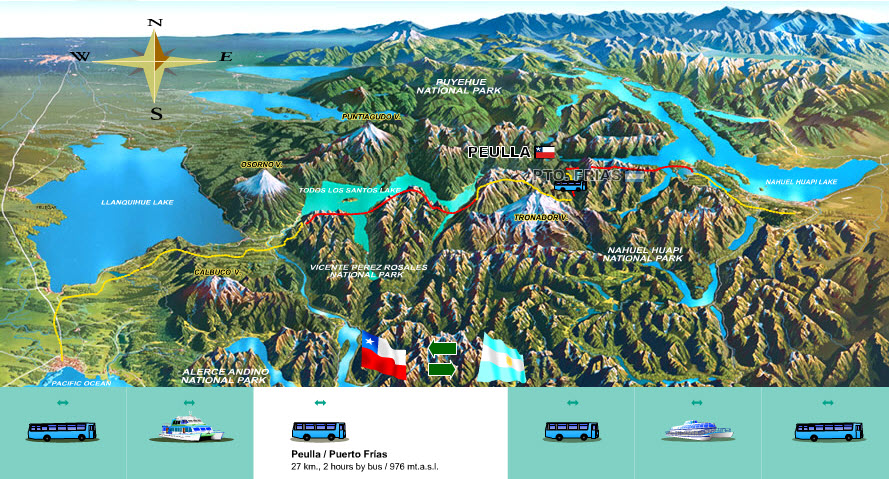
From Puerto Varas (or Puerto Montt), you can cross over in to Bariloche, Argentina via a series of boat and bus rides through gorgeous lakes and the Andes mountain range.   One company Turistur (?) has a monopoly on the trip (Cruce Andino) so it’s quite pricey ($230pp) and as far as I know, impossible to buy individual tickets for each segment of the trip which would presumably make it cheaper.

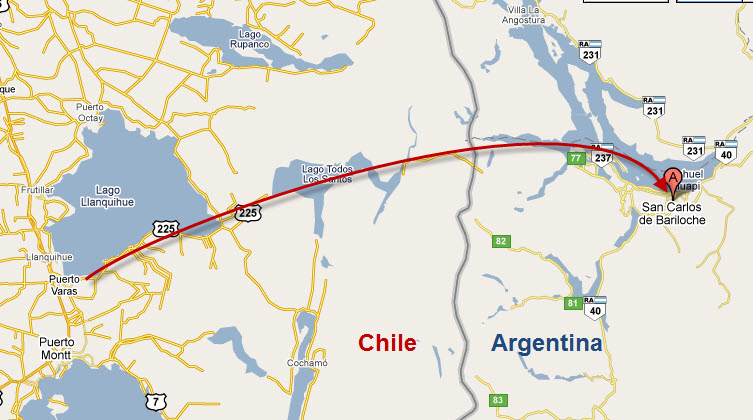
Here’s a map of how the trip goes, going from left to right, starting with the yellow line which means “bus”, and changing to red, which means “boat”:

Here’s a better map:

Despite how beautiful the views were, we don’t think it was worth the hefty price.  So, take a gander at the photos here, save your money, and take the bus to Bariloche instead.

20100324-DSC_0716-6

Saltos de Petrohue

Mount Tronador, Argentina
If you do take the trip, the Chilean side seemed to have better views.  The trip from Puerto Blest to Puerto Panuelo on the Argentine side was a bit boring and the catamaran we were on was already packed to the hilt with people when we got on.  Might as well have been a cattle boat.   And they all looked bored and tired.

A cattle boat, lakes crossing on the Argentinean side

But, still a good trip nonetheless!

20100324-DSC_0772-14

Want to see more photos? Click here to see more on Flickr

Categories
Chile

Puerto Varas, Chile – a 3 day delay on Lago Llanquihue

Puerto Varas, Chile

Total Miles Traveled: 10,126

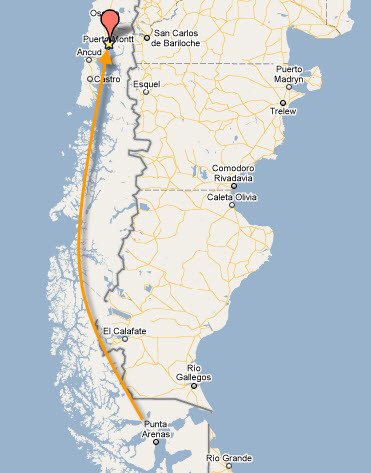
On a friend’s (Joey L.) recommendation, we flew from Punta Arenas to Puerto Montt in southern Chile with the plan to do the Lakes crossing over to Bariloche in Argentina, but first staying in Puerto Varas for a couple nights.  Here’s a map of the journey:

Puerto Varas is the “beginning” of the Lakes district, overlooking Lake Llanquihue and is flanked by two dormant volcanoes, Osorno and Calbuco (above).  It’s a pretty touristy town with brand names like North Face, Benetton, Orvis and other big brand name shops, a large modern casino with signs promoting Texas Hold’em (too bad we’re not really in to poker), and expensive restaurants lake side.  You can see that it’s definitely a summer vacation town because there is an abundance of lodging and restaurants, but when we were there, very few people.

Puerto Varas, Chile

Anyway, it rained for 3 days so we decided to delay our trip in to Argentina.   Not unusual for the area though, because they get 36 inches of rain per year.   So, not much to report outside of a couple of dining experiences below.

Before we get to that though, we’ve decided that in writing this blog, we’re going to be making some mundane notes about the places we stayed, just in case folks ask us about it later, because we probably won’t remember the details after some time.  Skim as appropriate!

To keep costs down, we stayed at a B&B called Tradicion Austral, which was literally someone’s house.  That said, John and Teresa were gracious hosts – John is originally from Indiana and lived in Fiji and Tahiti as a horticulturalist before moving to Chile to start a cranberry bog.  No joke.  The business opportunity was there because Ocean Spray owned most of the market in the U.S.  And he’s been in Chile for 10 years because he met his wife, Teresa, a native Chilena, who is super nice and helpful with travel arrangements.

As for food, we ate at Donde El Gordito one night, which was featured on Anthony Bourdain’s show at one point.  Here’s what we tried – first we had the Camarones al Pil Pil, because we were craving seafood after having meat almost every night in Argentina.

Camarones al Pil Pil (Tomato, Lime, Garlic)

Then, because there’s a lot of salmon (farming/catching) in the area, we had salmon “gordito” style, which was super rich – poached in butter with a butter-based salsa – very representative of the owner’s namesake, literally translated, “the fat one”.

Salmon "Gordito"

The lakeside restaurant, Mediterraneo, while OK, was overpriced (U.S. prices, if not more) and I suspect many of the lakeside places were also.  The other place we tried, Dominga, was a Japanese/Peruvian fusion place tucked away on the edge of town.  We had a couple rolls, which were kind of meh, and pricey for what they were.  Maybe Chile’s just more expensive than Argentina or maybe we went to touristy places.  Here’s a fried pork, ham, egg roll with a creamy sauce of some kind:

Puerto Varas, Chile

Want to see more photos? Click here to see more on Flickr

Next up, we cross the Lakes district in to Argentina.

Categories
Chile

Punta Arenas, Chile – land of wind, sheep estancias, and 11 penguins on the Strait of Magellan

Punta Arenas, Chile
Punta Arenas on the strait of Magellan

Total Miles Traveled: 9,304

From Torres del Paine, we traveled by bus about 5-6 hours, stopping briefly in Puerto Natales before arriving in Punta Arenas which overlooks the strait of Magellan to Tierra del Fuego.  It is the southernmost city in Chile (about 150,000 residents) and departure point for Antarctica.  The weather can be severe here, being nice and sunny in one moment and then cold, windy, and rainy in another.   Apparently, Richard Gere spent almost a month here while waiting for the weather to clear up so he could travel by boat out to Antarctica.

Outside of getting to Antarctica, Punta Arenas is known for its sheep farming and its penguin colonies at Seno Otway and Isla Magdalena.  The latter is said to have a population of 150,000 penguins, while the former has about 6,000.  Well, in our case, it was more like 11 penguins, that we could see at least.  But, we arrived late in the season and supposedly they were already migrating north to Brazil.   It would have been cool to walk amongst thousands of penguins, but alas, that was not the case.  Still cool to see them up close and in the wild though.

Magellan penguins at Seno Otway Sound
Magellan penguins on the beach at Seno Otway

One final note, we stayed at a rustic B&B tucked away in the forest called Casa Escondida.  Again, an interesting story to be told.  The co-owner, Luis, was a character.  At 17, he had bought a round-trip ticket from Venezuela to Houston, Texas to see Pink Floyd in concert.  He made it to the concert but didn’t take that return flight.  He returned to Chile some 11 years later after working in Houston near where I grew up (Greenspoint Mall) and studying music in Atlanta where he was a bass guitarist in a band.   Then, he got a degree in English education and became an English teacher in Santiago, Chile before starting the B&B with his wife in Punta Arenas.  And get this, he built all of the cabins and furniture by himself.  It took him the better part of 2.5 years full time…  Here’s a photo of the sauna he built:

The sauna at Casa Escondida

Want to see more photos? Click here to see a slideshow on Flickr

Categories
Chile

Torres del Paine, Chile – an awesome wonder

Torres del Paine, Chile

Total Miles Traveled: 9,102

We’ve crossed the border in to Chile to visit the famous Torres del Paine park.  It’s known for the “W” hike that can be done in about 4-5 days and without camping because there are basic shelters with full board along the way.  Alas, we didn’t do the hike (you outdoors types would be aghast) since we consciously chose to travel with roller bags to avoid carrying large packs for a few months or more.  But, we did see some gorgeous vistas and did a couple of day hikes in the area.

Before we get to the photos, a couple of interesting notes about the area:

1.) The mountains are wholly separate from the Andes mountain range.  They were formed from lava pushing up the granite and sedimentary rock from below, but the mountains themselves are not volcanic.  You’ll see in the pictures that the mountains are lighter colored at the base which is granite rock, and then sedimentary (darker) rock above.

2.) Some of the lakes have an unusual light blue color.  The color is a function of how much sediment from the mountains and glaciers is in the water.  The more sediment, the light blue/gray in color.

Without further ado, a few choice photos, and make sure to click to see more on Flickr.

Torres del Paine, Chile
Torres del Paine, overlooking Lago Nordenskjold
Torres del Paine, Chile
Lago Pehoe
Torres del Paine, Chile
A view of Torres del Paine from our cabin at Hotel Tyndall

Want to see more photos? Click here to see more on Flickr