Categories
Indonesia

Indonesian Cooking Class at Warung Enak, in Ubud, Bali

Cooking Class at Warung Enak, Ubud, Bali

If you haven’t guessed it by now, one of our goals this year is to learn how to cook the cuisine of the countries we visit.  We were intrigued by the menu presented by Warung Enak because it included dishes from across the Indonesian archipelago.

Here’s what our menu included:

  • Snack: Buntil Ayam, from Sumatra
    • Sticky rice stuffed with minced, chicken, ginger, and garlic, mixed with coconut milk, wrapped in pumpkin leaf
  • Appetizer: Otak-Otak Tenggiri, from Kalimantan (Borneo)
    • Minced white mackerel, wrapped in a banana leaf and grilled
  • Soup: Garang Asam, from Bali
    • Spicy seafood soup, in a lemongrass, chili, ginger, blue galangal, and turmeric broth
  • Main Course:
    • Pangek Sapi, from Sumatra
      • Spicy beef stew with basil, wing beans, and steamed rice
    • Bergedel Jagung, from central Java
      • Corn fritters served with urub sayur
  • Dessert:
    • Kue Lumpur, from Kalimantan
      • Mini pancakes with young coconut and raisins, served with vanilla and chocolate sauce
    • Pisang Rai, from Bali
      • Boiled banana beignet

Yeah yeah, I know what you’re thinking.  Holy crap.  That’s awesome.  When do you come over and cook for us?   Not so fast, boys and girls…  we haven’t even gotten to the photos yet!

The class started off with a trip to the local morning market which is where locals get their fresh produce.  Our instructor showed us the veggies we’d be using, many of which we didn’t recognize.   We’d learn later that there are substitutes for them if we can find them wherever we are.

Ubud market

Ubud market

Then, we returned to the restaurant for our cooking class, which we think until now, is the best cooking class we’ve ever taken.  Bold statement… why?  We cooked in the restaurant’s kitchen as if we were one of the staff, we prepared dishes that were served in the restaurant, we got 1:1 instruction from the lead sous chef, and the food we made tasted amazing.

It was less a class, and more like being a sous chef for a day – you felt the heat of the kitchen from the stove, grill, oven, and high heat wok station; you came to understand how tiring it was to stand up prepping and cooking for several hours; and you gained an appreciation for how much work it takes to put a dish together.  We even had the ingredients pre-prepared for us and it was still a good amount of work!

Cooking Class at Warung Enak, Ubud, Bali

Cooking Class at Warung Enak, Ubud, Bali

Cooking Class at Warung Enak, Ubud, Bali

One of our favorite dishes was the spicy seafood soup.  Look at all of the ingredients:

Cooking Class at Warung Enak, Ubud, Bali

The final product:

Cooking Class at Warung Enak, Ubud, Bali

Here are the corn fritters:

Cooking Class at Warung Enak, Ubud, Bali

And, here’s our favorite, the spicy beef stew served over rice and with blanched wing beans.   This one’s a keeper, and probably the first dish we’ll try to make when we have a proper kitchen.

Cooking Class at Warung Enak

Finally, what class would be complete without a certificate…

Cooking Class at Warung Enak

And now, we’re certified!  … or something.   So, when do you get to try some of this cooking?   If we can find the ingredients, and you have a proper kitchen and are willing to eat version 1.0 of our cooking, maybe we can work something out!

Check out the whole set of photos in the slideshow below:

[flickrslideshow acct_name=”tony-chen” id=”72157624939931909″]

Categories
Indonesia

Ubud, Bali – a Haven for Hippies in the Hills of Bali

Ubud, Bali

Total Miles Traveled: 34,615

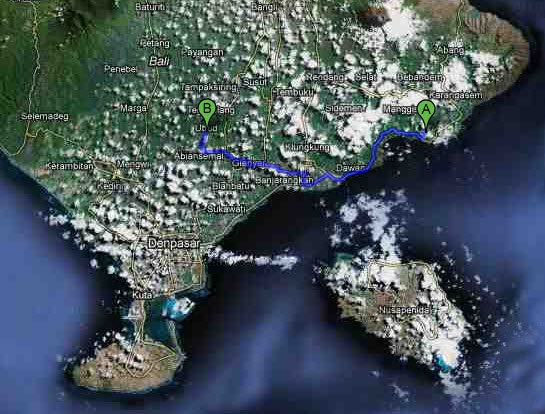
Ahh, Ubud.  It is described by many as a sanctuary for yoga, meditation, and just getting away from it all.  The book – and now film – “Eat, Pray, Love” has put Ubud in the spotlight since the main character finds her love there.  The film shot locally in Ubud with Julia Roberts, which has made Ubud even more of a destination.  Tour guides will inevitably mention it.   The funny thing is, we talked to a local and long-term expat about the book   He said the description of the “hunky”, love interest –  Felipe – gave him a chuckle once he realized it was the aging, balding guy he knew.  (Apparently the real guy looks NOTHING like Javier Bardem who portrays him in the movie.)

So, don’t let the book/film over-romanticize the place for you, because you’ll enjoy it that much more.  Despite all of the development and tourism, Ubud is still a pretty awesome place.  There’s a little bit for everyone – adventure, trekking, great food, cooking classes, yoga, meditation retreats, and some great shopping for clothes, jewelry, and home goods.
Interspersed between all of the fancy new buildings selling things in Ubud, there are still rice paddies with real farmers working on them to make a living.  Up to 80% of Balinese people are now involved with tourism according to one person we talked to.  The cynical part of me wouldn’t be surprised if some of these farmers are subsidized to keep the look and feel of the place intact.   In fact, if I were a public official, I’d definitely do it.

So, while Ubud is pretty developed, you still see slices of life as it was, like a boy flying his kite while running through the rice paddies.

Ubud, Bali

One thing that surprised us was the amount of women doing heavy manual labor.  These ladies are removing dirt from a small space between two modern buildings on the main street of Ubud.  They shovel the dirt into the bucket, lift it up on their heads, and then dump it in to the truck.

Ubud, Bali

One other memory we have is killing mosquitoes.  We stayed for a few days at Rumah David Sanctuary, where the rooms/bathrooms are indoor/outdoor.  And since Bali is a tropical climate with lots of standing water (think rice paddies), there can be lots (read tons) of mosquitoes.   Fortunately, there was an electric, rechargeable mosquito/fly swatter, which was a lot of fun to wave around the room and hear the snap, crackle, pop of things being zapped.  A bit weird?  Maybe.  But quite cathartic when these guys are constantly trying to bite you!

Killing Mosquitos, Ubud, Bali

We also remember the food and drinks being excellent in Ubud.   On one of our first nights, we hit up Cinta Grill for their buy-one-get-one-free mojito happy hour.  Fresh ginger mojitos, passion fruit mojitos, classic – we had’em all.   On subsequent days, we had some fantastic meals at Minami (Japanese), Lamak (Asian fusion), and Warung Enak (Indonesian).  At the latter, we took a cooking class which we’re write about in our next post.  Here’s Tony enjoying the BYGO Free.

Double-fisting Mojitos at Cinta Grill, Ubud, Bali

A Bike Tour through the Backroads

Our local expat friend told us to take a bike ride through the villages north and east of Ubud with a company called Bali Eco Bike Tours (a.k.a. Budaya Tours, I think).  It was a full day affair that takes you to various interesting points in the countryside via bus and bike.  The idea is to experience a slice of authentic Bali life.

Ubud, Bali

On one of our more touristy stops, we got to try Luwak coffee and learn how Bali coffee is made.  Here’s a cacao gourd/fruit.

Ubud, Bali

Luwak coffee is a specific type of coffee where the civit cat (below), eats the cacao beans and then “passes” them through their digestive systems.  The “poo beans” are washed thoroughly (thankfully), and then roasted.  It’s very expensive and rare, since it’s such low production, fetching up to $50USD/pound.  So getting to try it was a treat.

Ubud, Bali

Here’s a shot of Balinese coffee being roasted…

Roasting Coffee Beans, Ubud, Bali

The interesting thing about Balinese coffee in general is that there are  “male” and “female” beans, with the male ones being smaller and in smaller quantities.

Ubud, Bali

Here’s Lisa getting ready to try female Bali coffee (the most common and served in restaurants), male coffee (slightly bitter, like espresso – and more expensive), luwak (civit poo) coffee ($50USD per pound, nutty smooth flavor), ginseng coffee,  hot chocolate, and ginger tea.

Ubud, Bali

So what was the result?  Lisa liked the luwak (and most expensive) coffee the most.  Tony liked the female Balinese (and most common) coffee.  Go figure!

Getting back on our bikes, we stop at a household complex.   Rural families live in a complex of buildings, with a kitchen in one building, bedrooms in another, a temple, and so on.  Here’s the address sign for the one we visited. It includes a tally of how many people are living there, as specific as how many boys live there.

Ubud, Bali

Here’s a typical kitchen:

Ubud, Bali

Football (a.k.a. soccer to us Americans and Aussies) is truly popular around the world, including Bali.

Ubud, Bali

In Bali,  women will carry things, sometimes very heavy things, on their heads. WOW.

Ubud, Bali

Ubud, Bali

Ubud, Bali
The great thing about our tour was that you got to ride your bike through paved and unpaved paths through rice paddies, and mostly downhill.

Ubud, Bali

You got to see things like rice being dried:

Ubud, Bali

Here’s an interesting tree along one of our stops:

Ubud, Bali

Wood Carving

On another stop, we checked out people doing carved wooden doors.  Wood carving is big business in Bali for export.   We saw factories with tons of motorbikes parked outside where statues are mass produced by hand.   And along the roads, you can see stores with people carving doors, totem-like poles, and other decorations.  Maybe these people used to be farmers, but now are making products for export since it’s much more profitable.

One of these doors costs about $750 USD and takes about 1 month to make.  That’s very cheap for something of this caliber.  Imagine it after it’s stained and finished – dark wood carved front doors opening up in to your foyer.  Stunning.  We’ll be coming back to buy one (or more) of these some day when we have a home!

Carving Wood Doors

Lots of work goes into these carvings, but these guys are actually really quick.  And while each piece can be unique, there are patterns that they use to make it go faster.

Carving Wood Doors

Carving Wood Doors

Speaking of homes…here’s our future home.  Well, not really.  But, we’ll be copying it eventually.  It’s owned by some wealthy Balinese businessman who owns a bunch of tourist-oriented clothing and souvenir stores.   You can’t see it here, but his front door is a giant carved wooden door.  Really impressive.

Ubud, Bali

The Balinese People

As we rode through the backroads, we got to see what life is really like.  Like this photo below, where a rice farmer carries her hoe on her HEAD, yes, her head, and her sickle in hand.  The other women are making clay offerings which will later be heated to harden them, and offered up to their god at the temple behind them.

Ubud, Bali

One thing we’ve realized in our travels is that kids seem to be the same everywhere we go – they play the same, act the same, throw hissy-fits the same way.  And are all fun, too.   Do you agree?

Ubud, Bali

Ubud, Bali

Ubud, Bali

This guy approached us on the side of the road wanting to get a look at us and our cameras.  He kind of reminds me of my dad.  He’s wearing traditional headwear and a sarong for worshipping at temples.  We wish you could see the smile on his face when we showed him this picture in our digital camera.

Ubud, Bali

Finally, the bike tour came to an end for a late lunch:

Ubud, Bali

Ubud was definitely worth the visit.  If you get a chance to go to Bali, make time (more than two days — in fact more than a week) to get to know this area.  There’s plenty to see and do.  It can rejuvenate your spirit, even if you don’t do yoga or meditate!

For more photos, check our the slideshow below.

[flickrslideshow acct_name=”tony-chen” id=”72157624935808461″]

Categories
Indonesia

Tirta Gangga, Candidasa, and the Elusive Mola-Mola

Total Miles Traveled: 34,585

After diving in Tulamben, we were excited to head to a town called Candidasa (pronounced “chahn di dasa”) on the southeast coast.  We had heard that Nusa Penida is a great spot to find the elusive sunfish a.k.a. mola molas (pictured above).   They are the largest bony fish in the world, weighing a ton and about 6-9 feet long.  More on this later.

To get to Candidasa, we passed picturesque rice paddies…

Candidasa, Bali

.. and passed many Hindu temples.  Tirta Gangga (pictured below) is a larger temple for the water manifestation of their god.   We were told that official events were held there, but it seemed to be more of a tourist destination based on all the hawkers that lined the path to the temple.  Bali, by the way, is about 90% Hindu, with the rest being Muslim, Buddhist, and Christian.

Tirta Gangga Water Palace, Bali

Tirta Gangga Water Palace, Bali

Tirta Gangga Water Palace, Bali

Candidasa is a laid-back town compared to parts of southern Bali, but it, too, is developing at a rapid rate.   Before long, it may be just as crowded as other places in Bali.  The coastline is nice, but unfortunately, they harvested the reef for sand years ago, and that has resulted in erosion of the beaches.  So, there’s not much of a beach there, but if you like watching the waves, it’s quite nice.

Candidasa, Bali

Here are some girls, yes, girls, fishing in a pond in the center of town:

Candidasa, Bali

And, our visit to Bali wouldn’t be complete without some funny English translations. Think Jay Leno’s Headlines skit. Here’s the ad for Vincent’s… “MAYBE” the best in town. Only maybe.

Candidasa, Bali

Here’s an ad for a graphic design agency. Based on their ad, I wouldn’t even think of hiring them.

Candidasa, Bali

OK, this one is a little harder. The ad looks fine – dive with manta rays right? But look at what the company is called… “OK Divers”. Wha? You’re only O.K.? I want the best/safest dive shop, not just OK. Woops…

Candidasa, Bali

Our reason for coming to Candidasa:  to see the elusive Mola Molas

Photo Credit: q-dive bali

So, the whole reason we were in Candidasa was to see the mola molas.  But it turns out, diving Nusa Penida (a 30 minute boat ride away) is not only expensive, but quite rough and advanced as well.   Well, thankfully we  (1) took our seasickness meds (there were a couple divers who were in really bad shape), (2) are still respectably fit and (3) are comfortable diving; because the dives we did were physically challenging and potentially deep.   There are usually strong currents, and sometimes something called “washing machine” currents, where you can get tossed about, or “whirlpool” currents where you move in circles – which we definitely experienced!

On both of our dives, we ended up waiting at a depth of 60 feet, hanging on to dead coral to prevent ourselves from floating away due to the strong current, while our divemaster went deeper to look for the mola mola.  On the first dive he said he saw one, but it left and there was a heavy downcurrent on the way back up.  That means the water is pushing you down in to the depths of the sea.   Not fun, and very dangerous.

Needless to say, we decided to skip our second day of diving because we felt the risk/expense/reward just wasn’t worth it.  So instead, we looked up mola molas on Youtube.  And so can you.  Here’s what they look like in the wild.  Pretty amazing even just on video:

Alas, we’re done with diving for now and next we head to Ubud in central Bali.  Ubud is one of the places in the book and film Eat, Pray, Love.

Categories
Indonesia

Diving in Tulamben, Bali

Tulamben, Bali

Total Miles Traveled: 34,560

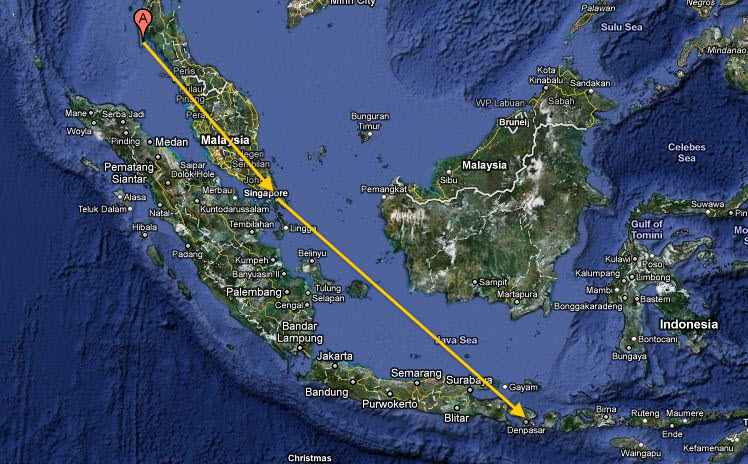
Wait, what? More diving? Yes… yes, really. We really like diving and we were keen to explore different diving (diving wrecks, diving with Nitrox, and seeing really unique ocean life.   So we asked ourselves, where else could we go right now where the diving is supposed to be superb?   The answer:  Bali, Indonesia.  Not only does it offer great diving but also boasts the best massage we’ve ever gotten, good shopping, good/cheap eats, and interesting cultural activities.

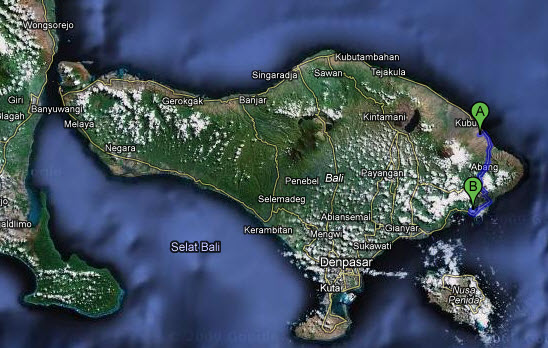
After a day of travel, we arrive on the northwest coast of Bali in Tulamben, where there is a WWII U.S. cargo ship called the U.S.S. Liberty, lying just 50 meters off the rocky beach. The Liberty was damaged by a Japanese torpedo and forced on shore before a volcanic eruption of nearby Mount Agung pushed it back in to the ocean. Today, it serves as an artificial reef and home to many sea creatures and fish.

Tulamben, Bali

To get to the dive sites, you simply wade in off the beach, ride on the back of a motorcycle in your wetsuit with your mask and fins, or ride in this wooden catamaran/dive boat.  The boat was fun to dive off of.  There’s no ladder to get back in.  You have to hoist yourself up after taking off all of your equipment in the water.  Luckily the waves weren’t too bad.

This is what they call “fish soup”:

Tulamben, Bali

When diving a wreck, you feel a little like Jacques Cousteau:

Tulamben, Bali

Tulamben, Bali

We picked up a little hitchhiker on one of our dives.   At first, I couldn’t figure out why Lisa was wiggling in the water, and the divemaster just pointed at her, but wasn’t concerned.  This, my friends, is a sharksucker – yes, a fish that sucks on sharks (or turtles or divers) for the stuff that grows on them – only this time, it’s Lisa’s butt!

Tulamben, Bali

After a while, Lisa and Mr. Sharksucker became friends:

Tulamben, Bali

Until Lisa somehow got rid of him and he ended up on my leg.  What did it feel like?  Nothing really.  Until you try to get him off.  Then he starts really sucking but not long enough to give me a hickey!

Tulamben, Bali

There were other cool things to see around the Liberty wreck, like this 5-foot long giant barracuda.

Tulamben, Bali

Check out this guy’s teeth!

Tulamben, Bali

On another day, we went to another dive site called Seraya Secret famous for its “muck diving,” which means the visibility in the water is low, but there are lots of small strange creatures to be found.

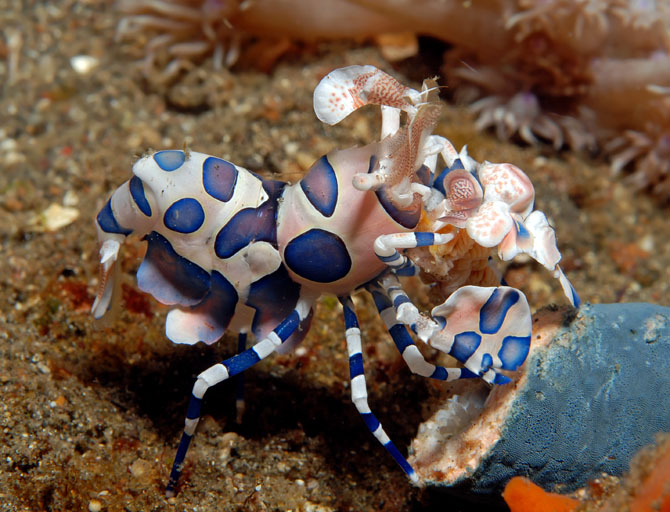
The star of this dive site is the harlequin shrimp pictured below.  I wish this were my photo, but my underwater photo set up is really, really poor (I’m still using an old 4 mega pixel point and shoot that doesn’t work all the time).   These guys are fun to watch and their diet is almost exclusively starfish.

Photo Credit: Dave Harasti

You’ve seen mantis shrimp before when we went to the seafood restaurant in Kota Kinabalu.  Here’s one hanging out in the open, which you don’t see very often because they’re hiding in their burrows.

Tulamben, Bali

Now here’s something super rare – a YELLOW mantis prawn. This blurry photo proves I saw it! I wish I could have lured it out with a chicken sausage!  Amazing.

Tulamben, Bali

Yet another awesome thing we saw at Seraya was a cleaning station full of shrimps, catfish, and a spotted moray eel.  Here’s what a banded cleaner shrimp looks like.  Apparently, if you go up to it and open up your mouth, these guys will crawl inside and clean your teeth.  I won’t believe it until I see it though.

Tulamben, Bali
Tulamben, Bali
Here’s a video of the cleaning station.  I could have watched this for the entire dive:

I think this one is called a snake eel, but not sure.  You only see his head poking out:

Tulamben, Bali

But then, when we came back at the end of the dive, this guy was out of his burrow doing who knows what.   There wasn’t anything around to eat…  But look at the camouflage on the head while the rest of it just looks like a regular snake.

Tulamben, Bali

On another dive, we came across two humphead (a.k.a. napoleon) wrasse.   Five feet long.  They’re huge.

And we found a huge field of garden eels feeding.  Here’s a video while I cruise over the field and they disappear in to their burrows.

Finally, here’s my favorite animal  – the elusive octopus.  We saw one on almost every dive, which is pretty rare.  I’m fascinated by how they can change colors to camouflage and how seemingly amorphous they can be:

And so, our dives in Tulamben come to an end.  Here’s a shot from 60 feet below the surface.  We often forget to look up when we’re diving, but sometimes some of the best stuff is up above:

Tulamben, Bali

Check out the rest of the photos and videos from our time in Tulamben below:

[flickrslideshow acct_name=”tony-chen” id=”72157624925259768″]