When you visit Hoi An, we highly recommend you go on Jack Tran’s Farm and Fish Tour. Here’s why… first, you’ll ride a bike through the countryside to a local farming area. The piles of green stuff in the foreground is seaweed which is used as fertilizer.
You’ll see how the farmers work the land:
Here’s how the farmers water their plants:
You get to try watering the plants yourself:
You get to try carrying buckets of vegetables with a bamboo pole. A lot harder than it looks and quite painful on your shoulder. The little woman this pole belonged to carries her veggies to the market every day using it.
They also allow you to ride an ox like this guy. But, notice the sharp horns and no saddle? You can’t see it, but the farmer is putting his finger on the horn as a safety measure. Even so, something tells me it’s going to hurt if you fall forward!
Then, we boarded a boat to see how the fishermen cast their fishing nets.
And got to haul in the catch:
Later, we’d get a chance to throw the nets ourselves, but on shore. Probably a good idea. Here’s Lisa’s attempt:
Here’s me:
Then, we got in these teacup boats, which are more of a novelty than having any functional purpose.
We ended with a delicious lunch on the boat. Overall a fantastic half-day experience – must do if you visit Hoi An!
Here’s a slideshow of all our photos. Beware there are over 100!
Hoi An is about to explode. Along the highway between Da Nang and Hoi An in central Vietnam, massive hotel resorts and retirement and condo communities are being constructed. There are little patches of normal life interspersed in between, but in a few years, many of these homes lining the street will become storefronts catering to the tourism industry, if they haven’t already.
Hoi An itself is an old port city located a few kilometers upriver from the coast. As such, its architecture is an amalgamation of the many cultures that lived there over the course of its history and because of its beauty, it has been designated a UNESCO World Heritage site. In fact, it’s not unlike the old port cities of Penang and Melaka in Malaysia.
There are many old Vietnamese homes you can visit that still have Chinese writing in them. Vietnamese was based on Chinese characters, but was romanized during French colonization.
Here’s one of the popular tourist sites, a bridge built by the Japanese:
Some photos of bikes we like. This one in a home next to a sink:
This one out in the street:
The old town area of Hoi An is set up for tourism, with hotels, restaurants, bars, and most notably, hundreds of tailoring shops where you can get just about anything you want made. In fact, it’s the thing to do in Hoi An. Walk in to any store and you’ll see samples of what you can have made, and in the higher end shops, they have flipbooks, even computers, showing photos with endless possibilities. It’s all a bit overwhelming, but man, it is a big business here. There are rooms full of seamstresses cranking out the suit you just got measured for:
Lisa had some nice clothes made that she was really happy with. If you do go, we recommend Yaly. They’re expensive, but they seem to have their act together.
We also took a cooking class where it started off with a tour of the market.
The class itself wasn’t great – more of a factory than anything. If you’re reading this in anticipation of visiting Hoi An, avoid the [] cooking school at all costs. They cram 30 people in to a room and try to run an interactive class where hot oil and special paring knives are involved, with only 2 helpers – 1 for every 15 people. That is a disaster waiting to happen, folks. On the plus side, the food we made tasted great:
All in all, I’d say you can spend 3 days in Hoi An and be done with it. If the weather is nice, you can stay on the beach like we did and stay longer. Only for us, the weather was cloudy and chilly most of the time. Oh well. At least they had a wifi signal on the beach!
There are a lot more photos from our trip in Hoi An – have a look at the slideshow below:
The Cu Chi tunnels are a network of tunnels that the Viet Cong soldiers and Cu Chi people lived in, hid in and fought from, when they were fighting American soldiers during the Vietnam War. Located about an hour outside of Ho Chi Minh city, it’s definitely worth a visit to learn how resilient and resourceful the Vietnamese were, and to fire some machine guns.
Note to future travelers: to get there, you can take a cheap bus tour with 30 people, or go via speedboat with a smaller group of 8 people). We did the latter, but we’re not sure it was worth the extra cost, which was 5-6x more. The boat cruise was much like the cruise we would eventually do on the Mekong delta, and even though you’re in a smaller group, there are large tour groups once you get to the tunnels, so you feel like you’re in a mob anyway.
Now back to the story… the original tunnels had tiny entrances that were covered with leaves.
It’s a bit of a tight squeeze, even for me!
The park ranger decided it would be funny to trap me down in the tunnel for a bit. I’m not claustrophobic, but it wasn’t comfortable down there!
Then a woman in our group, let’s just say she was a little bottom heavy, tried to get in the hole. Bad decision. After a little shimmy, she dropped in to the hole. But getting her out was a spectacle. Our tour guide and the park ranger had to lift her out by pulling on her jeans because she was stuck and couldn’t get out herself. I didn’t take a photo because it was not pretty at all – I had to look away.
Along the way, we saw some of the resourcefulness of the Vietnamese soldiers. They put together a number of nasty booby traps for the American soldiers. Many were camouflaged with leaves and you would fall in to these trap with spikes in them <shudder>
But one of the cooler things we saw was how they were able to cook meals underground. The smoke from their fires would be a dead giveaway for B52 bombers looking for a target. So, the Vietnamese built their kitchen chimneys such that the exhaust would be far away from the kitchen and tunnels. They also covered the outlet with a stone and wet leaves so that the smoke would seep out slowly, dissipating quickly across the forest floor. Here’s a photo of the chimney outlet:
We Shot Machine Guns!
One of the neat things you can do at Cu Chi is shoot a series of machine guns. You can choose from M16s, AK47s, M60s and many others. We chose M16 and AK47, the most used rifles during the war.
It’s big business for the Cu Chi park – about $1 USD per bullet. Here’s one small pile.
Here’s Lisa shooting the AK47 – it had a wicked recoil. And these guns are LOUD. Really really loud.
Here’s a video of me with the M16 doing single shots.
I must say though, firing the AK47 on full automatic was more fun, even though it ended in 3 seconds. Can’t imagine it being fun during the war though.
The Tunnels
Finally, we got to crawl through a 100 meter segment of the tunnel system that had been enlarged for tourists. Even so, it was still quite hard to crawl through. At some points, you had to get on your hands and knees because it was so little. Other times, you would crouch over and walk with your body in a 90 degree angle or walk duck style which was a great workout for the quads.
Definitely not for the claustrophobic, and it was actually quite a workout crawling through the tunnels because they would go up and down and side to side. Here’s Lisa, relieved to be out of the tunnel.
Have a look at all of the photos in the slideshow below:
Several friends and travelers advised us to get out of Ho Chi Minh City to see the Mekong Delta – we were glad we did.
We took a 2-day cruise on the Bassac boat, from Cai Be to Can Tho. It turned out to be a fantastic way to see the area and way of life in the countryside.
The Mekong river [wiki link] starts in Myanmar, passes through Cambodia and flows down to the coast of south Vietnam. It is THE transportation network and foundation of the economy in the area. So, people live by the river – check out the antennas on these homes to get a TV signal!
… and on the river in boats. And sometimes both.
The back of the boat is usually where people make dinner:
And clothes are not washed in machines, but in the muddy river.
One major industry is harvesting dirt and rocks…
… and then you have to transport it. The dirt is so heavy that the boats are made to travel almost completely submerged.
Where does the dirt go? Well some of it is used to make bricks in these huge kilns.
At the end of our first day, we had a torrent of rain just after sunset:
The next day, we woke up before dawn to visit the floating markets. Yes, one of the rare days we see the sunrise, but it was worth it!
Where do you go buy the freshest produce? You go to the floating markets where vendors transport fruits and veggies direct from farms to its buyer, all via boat. You can tell what each boat is selling because of the fruit or vegetable that is hung on a pole extending up from the boat.
Here’s a customer, driving her self-powered SUV to the market:
Check out the morning commute – look at all of the bikes!
Or the ferry!
Here’s a look at life on land. The Mekong delta is also known as the Rice Bowl of Vietnam. Many a rice paddy are found here:
Life is simple – people work hard and live off the land. Growing season is year round.
And as we’ve noted before, kids appear to behave the same around the world… well mostly. These kids have learned the peace sign that is oh so common around Asia:
Here’s a boy blowing a blade of palm to make a kazoo-like sound:
Have a look at all of our photos from our trip to the Mekong Delta:
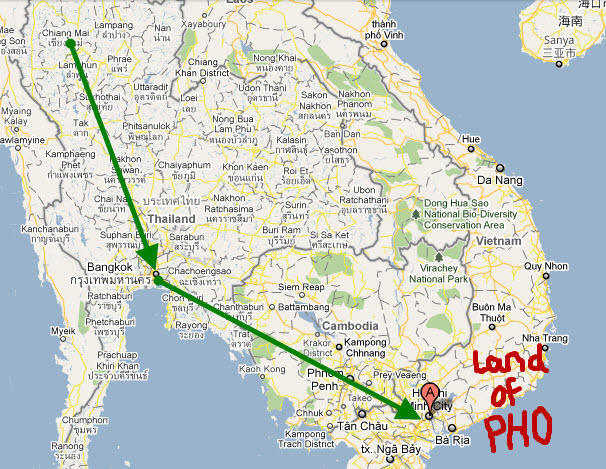
Days before we left for Vietnam, it started. Tony would make a little comment here, a twitch there. I knew I was in for trouble. Tony had a need and it could only be satisfied in Vietnam.
Pho!
Tony had fallen in love with this dish long before I had met him. As Tony describes it: “Pho is the ultimate comfort food. It’s yummy goodness in a bowl. It has everything – beef, pork, seafood, vegetables, spice, salt… aghmhhm.”
When we landed in Ho Chi Minh City (also known as Saigon before and during the Vietnam War), it was around dinner time and luckily we didn’t have to go far to find a restaurant famous for Pho. Pho Hoa is a little restaurant with a big reputation, having been in its location since the 1960s. We understand that many restaurants in the U.S. have used the same name and try to mimic the original. Since Pho is typically a breakfast item, we didn’t have to wait long to get a bowl for dinner.
Check out the anticipation…
And then the utter joy …
We loved this restaurant’s unlimited fresh herbs – which included basil, sawtooth coriander and regular cilantro. Unlike other dishes which taste much better in their native country, this Pho tasted similar to the Pho we find in the US (but better).
With full bellies and Tony’s satisfied grin, we faced our next major obstacle – how to get home. Between us and our hotel were wide roads with heavy traffic that needed to be crossed. But without any traffic lights and with a seemingly endless line of motor bikes and cars, we were at a loss. Tony called it ‘amoeba’ traffic because motorbikes and cars seemed to be going in all different directions. It just didn’t end.
After a few failed attempts, we found a local and used them as a human shield. When we got back to our hotel, we researched how to cross streets in Viet Nam. Had we read a guide book, we would have learned that crossing the road is a big deal for tourists. Luckily there is a trick. You HAVE to learn the trick or you will not be able to walk anywhere in HCM (or Viet Nam).
The trick = finding a break when there are less bikes and then cross slowly and steadily. The motorcyclists are used to this and will avoid you. It actually works really, really well! Here’s a shot we took as we crossed.
With our newfound skill in place, we ventured out on the town. We visited the Reunification Palace. The Palace was the home and workplace of the President of South Vietnam during the Vietnam War. It was also the site of the end of the Vietnam War during the Fall of Saigon when a North Vietnamese army tank crashed through its gates.
The Palace was constructed in the early 60s and has been well preserved. Check out that 60’s style!…
… and the phones… there was even the infamous ‘red’ phone still displayed in the President’s office.
We also visited the War Crimes Museum which was a pretty depressing and somewhat (North Vietnamese) biased look at the atrocities of the “American War” as the Vietnamese call it. It’s definitely worth a visit (unless you are a Vietnam Vet), but be prepared for propaganda and some gruesome photos.
And – of course – we ate! We tried to find where the locals go and try local / regional specialties. Banh Xeo – which literally means ‘sizzling cake’ – is a savory pancake or crepe with shrimps, pork, mung bean sprouts and then fried. You are meant to stuff it with herbs, and then dip in fish sauce. Here’s how they make it:
And here’s what it looks like. We also ordered a few other dishes to go with it.
Stay tuned for our trip up the Mekong Delta and into the Cu Chi Tunnels.
Click through to see our full set of photos from Ho Chi Minh City: